
The official app won't tell you which platform your train leaves from. A Korean dev built "KTX Flighty": Railiv on its ninth day in the store
What it is A Korean train app: enter your ticket number and see this KTX's boarding platform, delay, and location on your lock screen, Dynamic Island, and watch. It also logs your rides automatically. Pro is ₩3,300 a week.
Why it took off After the September merger, Korail+ (the official app) got hammered for missing platform numbers and delay info, which are exactly the features Railiv charges for. The first trip is free with Pro, Meta ads optimized for "Start Subscription" launched the same week, and it sits in the low-bar travel category, so a few subscriptions were enough to chart.
CHow to copy it Don't build a Korean KTX app. Copy the playbook: find a country or setting where the official travel app is getting roasted and the live data is public. Build only "my train" on the lock screen with live activities plus key alerts. First trip free, then weekly billing. Wire up subscription postbacks to Meta from day one.
Est. monthly revenue (App Store) under $1KWe estimated this from its chart ranks and rating growth across storefronts, calibrated against verified revenue; typical error is 2–3x. Read it as a tier, not an exact number.
- Data (updated daily) · First launched 2026-11-08 · Korean rating 0 · 11-20 charted in 1 stores
iOS · best category chart rank · by store Data 2026-11-17 → 2026-11-20 (4 days, 4 observations). Lower rank is higher; gaps mean it wasn't charted that dayiOS · rating count · Korea Data 2026-11-14 → 2026-11-20 (7 days, 5 observations). Apple doesn't publish download counts; rating growth is a proxy for downloads.
After South Korea's national rail app merged and redesigned in September, the thing passengers complained about most was this: the platform number they need 15 minutes before departure just doesn't show up, no matter how often they refresh. On Nov 8, an indie dev named MINU JUNG launched 레일립 Railiv: enter your ticket number and the platform, delays and live position of your train go onto your lock screen and Dynamic Island. The first trip is free, after that it's paid weekly. Nine days after launch, it hit #24 on the Korean store's Travel Top Grossing chart, with zero ratings. It's far from proven, but how it was getting paid in its first week is worth a look for anyone building utility apps.
A person who missed a train because the platform number never appeared
On Oct 8, the Korean App Store one-star review for Korail+ (the official app of Korea Railroad Corporation) was titled "Please show the platform number when transferring": "First time transferring trains, the platform number for the second train didn't show on my ticket. I walked around the station and missed it."
Several reviews that same week said the same thing. Oct 5: "Since the update, the platform number doesn't appear even 15 minutes before departure, even after refreshing. Last month I ran the whole way because of this." Oct 23: "The platform info should have shown 15 minutes ago, and it still hasn't after 15 minutes." Nov 15: "I refreshed the ticket page and the platform still isn't updating. I had to close the app and reopen it." Checking delays also got harder. On Oct 8 someone wrote: "Before, tapping my ticket showed how many minutes late the train was. After the update, you have to tap the ticket again to see it."
The complaints have a clear starting point. In Aug 2026, the 3-year-old 코레일톡 was overhauled into 코레일+, merging train booking for KTX and SRT into one app. In Sep 1, the two operators officially merged, fares dropped by about 10%, and up to 17k more seats became available per day (per KBS and Yonhap). More people were riding, but the official app got harder to use. 코레일+ currently has 1,398 ratings and a 1.42-star average in the Korea store. Of the 200-plus reviews from mid-Sep to mid-Nov, the average is around 1.2 stars, and more than twenty of them complain about the same three things: platforms, delays, and train position.
What Railiv is
In one line: it brings Flighty's model (the app that tracks flights on your lock screen) to Korean trains.
You buy your ticket on Korail, open Railiv, and enter the ticket number. It pulls up the train number, car, and seat right away. After that you can see where the train is on a map, the estimated departure and arrival times, how late it is, the boarding platform, and get an alert when you're near your stop. There are also station displays, seat maps, and weather at both ends. Rides you've taken are automatically logged with stats, like Flight's flight log. No account is needed. The website and privacy policy say ticket lookups connect from your phone directly to Korail, and the ticket number, seat, and location are not uploaded to its servers.
It covers ten train types including KTX, ITX, Saemaeul, and Mugunghwa. It only does intercity rail, not subway. It's Korean-only and only listed in the Korean store, with a minimum iOS version of 18. The last line of the store page says it has no partnership with and no official certification from Korea Railroad Corporation.
How it charges: the first trip is free, then you pay per week
The free version already works: timetable, location, delays, platforms, drop-off alerts, and widgets are all there. Pro is what you pay for:
- Live activities and real-time running info on the lock screen and Dynamic Island, live widgets, and Apple Watch;
- All the "platform confirmed" and "delayed" push notifications turned on;
- Every stop's timing, delay stats, and backfilling of past trips.
Prices (in-app purchases, Korean store): weekly ₩3,300 (about $2.3), monthly ₩9,900, 3 months ₩19,900. No annual plan.
The smartest part of the design is how the trial works: it's not "free for 3 days," it's "the first train you register is free with Pro." So the moment a user is standing on the platform and sees "Platform 3, 4 min late" pop up on their lock screen is exactly when the paid feature is most useful. If they want it for the next train, they have to subscribe. Billing is weekly, which fits people who take a KTX once or twice a month. The free allowance is also tied to the App Store transaction ID, so deleting and reinstalling doesn't give you another one.
How big it is now: small, and the chart bar is low
| Date | Version | Korea travel category, Top Grossing | Korea travel category, Top Free | Score |
|---|---|---|---|---|
| 11-08 launch to 11-16 | 0.3.x | Not in the top 200 | — | 0 |
| 11-17 | 0.4.1 | 24 | 199 | 0 |
| 11-18 | 0.4.1 | 25 | 206 | 0 |
It's #24 on Top Grossing but beyond #200 on Top Free, which means few downloads, but a decent share of those downloaders pay. That matches the "first trip free, then pay" design (inferred).
But don't read too much into a #24 ranking. 11-18 In the Korea store's Travel Top Grossing chart, #20 through #30 are: ATC Live (10 ratings), tripbff (77), Couchsurfing (200), StaffTraveler (32), Railiv (0), WikiCamps Australia (3), World Map (2)... Getting onto this chart takes only a few subscriptions a day, which works out to a few hundred dollars a month (my estimate; revenue isn't public).
It's also barely known: no media coverage, and X, Threads, Korean rail forums, and Clien turn up no one else talking about it.
Where users come from
Meta ads, starting the same week it launched. Its privacy policy is clear: to measure Railiv ads on Instagram and Facebook, installs, opens, and "Start Subscription" events (including product and price) are sent to Meta via AppsFlyer. So from the start, it had Meta looking for people who pay, not people who download. The Instagram account @railiv.app and the Facebook page were both created in Nov 13, with 9 posts published on the same day and 0 followers. These are accounts for running ads, not for content. I couldn't find the ad creative, budget, or start date in the Meta Ad Library (11-18, Korea).
App Store search. 11-18 ranks #1 in Korea for "열차 추적" (train tracking), "열차 기록" (train record), and "기차 여행 기록" (train travel log), #3 for "KTX 실시간" (KTX live), and #6 for "기차 실시간" (train live). None of these terms are big, but it holds them.
Choosing the category. Similar subway apps (이번정거장, 지하섬, RailNetwork) are in the Navigation category, where the top spots on the Navigation chart are taken by them. Railiv is in Travel, where the #25 spot's neighbors have only single-digit ratings. Putting a transit app in the travel category gets it visibility with a few subscriptions. Whether that was intentional is unknown (inferred).
Who it's competing with
| Product | What it is | How Railiv is different |
|---|---|---|
| Korail+ (official) | Ticketing app, #4–7 on Korea's travel Top Free chart | Can also show train location, but the platform number often doesn't appear, you have to tap again to see delays, and there are no lock screen live activities |
| SRT (official) | Ticketing app, 3,555 ratings, 1.41 stars | Also has no real-time tracking for individual trips |
| RailNetwork | Indie developer, listed 2024-06, iOS 43 ratings at 4.35 stars, with Android, web, and English | Closest in features: subway plus Korail real-time location, Dynamic Island, and watch support, with ads plus subscriptions. It centers on maps and lines, tracking "all trains on this line." Railiv centers on the ticket and tracks only "my train." |
| 이번정거장 | Subway drop-off alerts with subscriptions, listed 2024-02, Korea Navigation Top Grossing #3–8 | Proves Koreans will pay for subscriptions in transit apps, but doesn't cover KTX |
| 지하섬 | Subway Dynamic Island drop-off alerts from 2026-07, best Navigation Top Grossing rank #3 | Same playbook, aimed at subways; the developer promotes it on Threads themselves |
| 기차시간표 | Launched 2026-10-15, 0 ratings | Timetable with departure countdown, free, no location or delay info |
| Flighty | Flight tracking, #2 on Korea's travel Top Grossing | The flight version of the same thing, the prototype for Railiv |
| A batch of free web-based train maps | liverailmap.com, trainstracking.com, and others | Mostly estimated from timetables, with no individual trip tracking or push alerts |
So the official site's line "국내 유일 실시간 열차 추적 앱" (Korea's only real-time train tracking app) is an overstatement, since RailNetwork can track KTX too. But "track my train by my ticket, put it on the lock screen, charge weekly" is, for now, only Railiv.
Its biggest weaknesses
First, the data isn't in its own hands. Ticket lookups connect from the phone directly to Korail, and that isn't a public API (inferred). If Korail changes or blocks it, the core feature breaks. Second, the official app could catch up at any time. With Korail+ getting this much flak, if the next version adds platform push alerts or live activities, half of Railiv's reason to charge disappears. Third, growth is all paid. There are no ratings and no word of mouth yet, and the weekly price is ₩3,300. Whether renewals can cover the acquisition cost per subscriber isn't visible from the outside.
If it were you
C. Railiv shows that when an official app is getting roasted, a paid little tool that only tracks your train can take money in week one. But it hasn't proven it can scale yet, and Korea's slot is already taken by it and RailNetwork. What's worth learning is its approach, not its position.
Who it suits: an iOS developer who writes Swift and knows live activities and Apple Watch, who often rides trains or long-distance buses in a country where the official app is clumsy, and who knows where the public operating data is.
Who it doesn't suit: anyone who wants to build a Korean KTX app directly (Railiv and RailNetwork already exist, and the official side could fill the gap); anyone who can't get stable data and would have to scrape the official app's endpoints; anyone unwilling to spend on ads and hoping for organic traction.
How to build it: find a setting that meets three conditions. The official app was recently redesigned or has been criticized for a long time. Live operating data is public and accessible. Users have a concrete worry while on the platform or waiting for a train (platform number, delays, transfers). Build only "my train": enter a ticket number or train number, add a lock screen live activity plus two or three key alerts (platform confirmed, delayed, nearing your stop), and add an automatic ride log. Copy Railiv's trial wording: "first trip free" rather than "3-day free trial." Price weekly for infrequent travel. Put "no account, data never goes to our server" on the first screen of the store listing.
How to acquire users: before launch, connect AppsFlyer (or similar) to send "Start Subscription" to Meta, run a small Instagram budget, and shoot the creative around the one second when the platform number pops up on the lock screen. In the store, claim small keywords like "XX train tracking" and "XX live" first. Pick the category with the lowest bar on the Top Grossing chart. Then read the negative reviews on the official app. Those exact phrases become your ad copy.
Deadline: the window when an official app is getting roasted doesn't last long. When a country's rail app has just been redesigned and complaints are piling up, launch before it gets fixed. You should see renewals within three months.
Signs you misjudged it: (1) Railiv drops out of the top 100 on Korea's travel Top Grossing chart within a month or two, and its ratings are still single digits. That would mean the first week's subscriptions were bought with ads and won't renew. (2) Korail+ adds platform push alerts or live activities in the next few versions. That would mean this kind of "official gap" gets filled quickly and the window is shorter than it looks. (3) Railiv stops working for a long time because Korail changed its endpoints. That would mean relying on the official app's endpoints doesn't work, and you should only pick countries with officially open data.
Ads it's running
Meta has shown us 2 ads; 2 are still running, earliest from Nov 2026 17.
Meta · Video · Running for 4 days · Still running · View original ↗
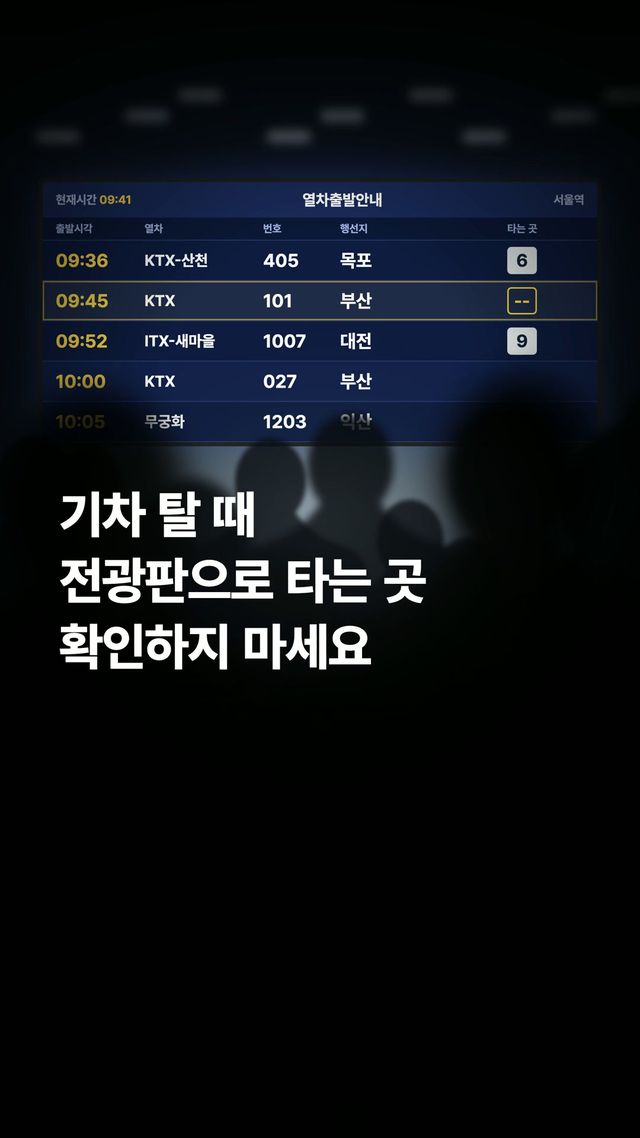
타는 곳, 이제 알림으로 받으세요타는 곳 뜰 때 까지 전광판만 보고 계신가요? 내 기차의 타는 곳이 정해지면 레일립이 바로 알려드려요.

Meta · Video · Running for 4 days · Still running · View original ↗
빠르게 알려주는 타는 곳 알림기차 타기 전 기차앱 계속 들어가 보시나요? 이제는 잠금화면에서 실시간 지연, 위치, 타는 곳 까지 한 번에 알려드려요.
These are the longest-running ads in this set. Long runs usually mean the creative is working. Data comes from the official Meta, Google and TikTok ad libraries and updates daily; open the official library to view the original creative.
Research notes: competitor table, acquisition evidence, full research report
- Competitors
Name Where Launched Scale How it differs from this one Korail+ (formerly Korail Talk) iOS 2015;2026-08-03 merged into SRT with a redesign Korea Travel free chart 4–7; 1,398 ratings, 1.42 stars; 265 reviews in the library averaging 1.23 The official ticketing app, and it also shows train position, but platform numbers only appear 15 minutes before departure and don't refresh, checking delays takes an extra tap, and there are no live activities. Railiv doesn't sell tickets; it only does lock-screen info and push alerts for this one train RailNetwork iOS 2024-06 iOS: 43 ratings, 4.35 stars, Korea Navigation free chart 69–209; also on Android and the web Map- and line-centric, subway plus the full Korail network, ads plus subscriptions, with English for tourists. Railiv is ticket-centric, covering only intercity rail, with a Flighty-style ride log SRT - 수서고속철도 iOS 2019 3,555 ratings, 1.41 stars The official ticketing app, with no real-time tracking of an individual's trip 이번정거장 iOS 2024-02 926 ratings; Korea Navigation Top Grossing 3–8 Subway exit alerts plus subscriptions, not covering KTX; shows Korean commuters will pay a subscription for transit apps 지하섬 iOS 2026-07-22 108 ratings; best Navigation Top Grossing rank #3 A subway version of Dynamic Island exit alerts, promoted on Threads; the audience is subway riders, not intercity rail 기차시간표 iOS 2026-10-15 0 ratings Only a timetable and a departure countdown Live Activity, free; no live position, delays, or platform alerts Flighty iOS 2019 Korea Travel Top Grossing #2 The same playbook as a flight app (Live Activities, delay alerts, flight log, subscription); Railiv brings it to Korean rail liverailmap.com / trainstracking.com / railnow.runvia.app / rail.it.kr Web Unknown Unknown Free web train maps and timetables, with no personal trip tracking, alerts, or lock-screen support - Where users come from
- Confirmed Meta (Instagram / Facebook) paid ads + AppsFlyer postbacks for subscription events: the privacy policy says measurement is done for Railiv ads on Meta, with installs, launches, and subscription starts (product ID, price) sent back via AppsFlyer. IG @railiv.app and the FB page were created 11-13, 9 posts went up the same day, 0 followers; ScrapeCreators found 0 KR ads in the ad library, creatives not found
- Verified App Store search: 11-18 Korean store searches: 「열차 추적」「열차 기록」「기차 여행 기록」at #1, 「KTX 실시간」at #3, 「기차 실시간」at #6 (iTunes Search API)
- Confirmed Category choice (Travel, not Navigation): transit rivals all sit near the top of Navigation Top Grossing; Travel Top Grossing #20–30 is held by small apps with only 2–200 ratings, so 0 ratings can get you ranked #24–25
- Confirmed Official landing page: railiv.kibitzworks.com (with a mirror at railiv.spub.kr); the privacy policy mentions logging web visits
- Inferred Threads / X / community / press mentions: Jina, Exa, Brave, and x-radar found no third-party mentions
Railiv (ios_6817802921) research report
An iOS app by a Korean indie developer (MINU JUNG / kibitzworks) for real-time tracking of "my train" across KTX, ITX, Mugunghwa and other Korean rail, plus a ride log. Launched 2026-11-08, Korean only, Korean store only, Pro subscription (weekly ₩3,300 / monthly ₩9,900 / 3 months ₩19,900). Data dates: App Store library through 2026-11-18; web search 2026-11-17/18.
Conclusion first
Strictly speaking, it hasn't broken out yet. It has only surfaced on a low-bar chart. On day 9 after launch (11-17) it hit #24,11-18 on the Korean iOS Travel Top Grossing chart, #25; rating 0; the same day the Travel Free chart ranked only 199 / 206. Its neighbors on the grossing chart are small apps like WikiCamps Australia (3 ratings in Korea) and World Map: Visited Countries (2 ratings), so #25 probably only takes a few subscriptions a day (estimate, unverified).
Getting paid in the first week came from three things stacked together:
- The official app is annoying people, and the pain point is clear. 2026-08-03 Korail Talk was rebuilt as "Korail+", a merged KTX and SRT app, 9-01 under joint operation. Our library has 265 Korail+ reviews in Korea (09-17 to 11-16) averaging 1.23 stars, and 25 of them directly complain about "타는 곳" (platform), "지연" (delay), and "위치" (train position): platform numbers only show 15 minutes before departure, refreshing doesn't update them, and delay info needs an extra tap. Railiv's paid features are exactly these: platform-confirmed alerts, delay alerts, and lock-screen Live Activities.
- Bringing Flighty's approach to Korean rail. Live Activities / Dynamic Island, Apple Watch, auto-generated ride logs, and delay statistics: this setup was proven on flights by Flighty (Korea Travel Top Grossing #2). For Korean rail, neither the official app nor independent apps have built "my train" into a paid product like this.
- Meta ads bought the same week as launch, with AppsFlyer postbacks on "subscription start". The privacy policy says measurement is done for Railiv ads on Meta (Instagram and Facebook), with installs, launches, and subscription starts (including product ID and price) sent to Meta via AppsFlyer. The IG @railiv.app and FB page were only created 11-13, 9 posts went up the same day, and followers reached 0. This is an account for running ads, not for creating content.
The differentiation (Live Activity + one-tap registration by ticket number + a free first trip with Pro + no account) is likely why it's getting paid; whether it scales depends on ad ROI, and there is no evidence of that yet.
---
1. Data: how big it is right now
| Date | Version | Korea travel category, Top Grossing | Korea travel category, Top Free | Score |
|---|---|---|---|---|
| Listed 11-08 | — | Not in the top 200 (11-08 through 11-16 full daily 200-rank charts exist without it) | — | 0 |
| 11-14 | 0.3.5 | — | — | 0 |
| 11-17 | 0.4.1 (11-15 releases) | 24 | 199 | 0 |
| 11-18 | 0.4.1 | 25 | 206 | 0 |
Source: appstore library chart_rank / app_day (kr, genre 6003).
- Listed in the Korean store only, Korean only, minimum iOS 18.
- 11-18 Korea Travel Top Grossing #20–30: ATC Live (10 ratings), tripbff (77), Couchsurfing (200), Meta On Meta (26), StaffTraveler (32), Railiv (0), 수원화성의 비밀 (20), WikiCamps Australia (3), 항공편 추적기 (13), World Map (2). The bar in this range is very low, and the revenue at #25 is probably on the order of a few subscriptions a day, a few hundred dollars a month (estimate, unverified).
- Top Grossing #24 but outside the top 200 on Free: few downloads, but a fairly high share of them pay. This matches the design of "free first Pro trip, you have to subscribe for the next one" (inferred).
2. What it is and how it makes money
App Store description and official site railiv.kibitzworks.com:
- Free: timetable search (10 train types including KTX, ITX, Saemaeul, Mugunghwa), train position on the map, estimated arrival and departure times, delays, platforms, exit alerts, station displays, all stations and line maps, seat maps, weather at origin and destination, automatic ride log and statistics, home and lock-screen widgets, Shortcuts / Spotlight / Siri, iCloud sync.
- Pro: Live Activities / Dynamic Island, live widgets, Apple Watch, all intermediate stop times, delay statistics, full push alerts for "platform confirmed / delay occurred", and backfilling past trips. Your first registered trip gets a free Pro trial.
- Pricing (Korean App Store in-app purchases): weekly ₩3,300, monthly ₩9,900, 3 months ₩19,900. No annual plan. The weekly option targets people who ride occasionally.
- Sign-up method: on the official site, 「승차권 번호로 1초만에」 — enter the ticket number and the platform, car, and seat come up instantly. The privacy policy states that when checking tickets, the phone connects directly to Korail with the ticket number and does not pass through Railiv's servers.
- No account. The server only uses a random device ID; ticket numbers, seats, location, and routes are not uploaded (per the privacy policy). Servers are hosted on Oracle Cloud in Chuncheon; Sentry, AppsFlyer, and Apple WeatherKit are used.
- States it has "no partnership with Korail and no official certification." Data comes from Korail's public operating information and ticket lookups.
3. Competitors
| Product | Where | Launched | Scale | How Railiv is different |
|---|---|---|---|---|
| Korail+ (formerly Korail Talk, id 1000558562) | iOS / Android, official | 2015;2026-08-03 merged into SRT with a redesign | Korea Travel free chart 4–7; iOS 1,398 ratings, 1.42 stars (recounted after the rename); library reviews from the past two months 265 averaging 1.23 | Handles ticketing and also shows train position (2024-07 plus "열차도착정보", 2025-03 the government's promoted "철도위치확인"), but platform numbers only appear 15 minutes before departure and don't refresh, checking delays takes an extra tap, and the description doesn't mention live activities or watch support. Railiv doesn't sell tickets; it focuses on the experience of "my train" |
| SRT - 수서고속철도(id1350286957) | iOS, official | 2019 | 3,555 ratings, 1.41 stars | Same as above, official ticketing app |
| RailNetwork(id6474718165,Byeonghyeon Jeon) | iOS + Android + web at railnetwork.kr | 2024-06 | iOS 43 ratings, 4.35 stars; Korea Navigation free chart 69–209; has English and targets tourists | The closest in features: subway plus Korail live train position, Dynamic Island, watch, widgets, line maps, and car composition info, with ads plus subscriptions. It centers on Seoul-area subway and rail enthusiasts; Railiv only does intercity rail, centered on "the train on my ticket," plus a ride log |
| 이번정거장(id6476115767) | iOS | 2024-02 | 926 ratings; Korea Navigation Top Grossing 3–8 | Subway exit alerts plus subscriptions, showing Korean commuters will pay for transit apps; does not cover KTX |
| 지하섬(id6792708146) | iOS | 2026-07-22 | 108 ratings; best Navigation Top Grossing rank #3 | Subway exit alerts plus Dynamic Island, promoted by the developer on Threads; same "transit + Live Activity + subscription" formula, but the audience is subway riders |
| 기차시간표(id6820400912,Daecheol Kim) | iOS | 2026-10-15 | 0 ratings | Timetable plus departure countdown Live Activity, free; no live position or delays |
| 레일로그 / Train Net / 테츠로그 | iOS | From ¥2026-07 | 0–1 ratings | A rail-enthusiast stamp and check-in collection; overlaps with Railiv's automatic ride log but has no live tracking |
| Flighty(id1358823008) | iOS | 2019 | Korea Travel Top Grossing #2 | The same setup as the flight version: Live Activities, delay prediction, flight log statistics, subscription. Railiv is essentially "Flighty for KTX" |
| liverailmap.com, trainstracking.com, railnow.runvia.app, rail.it.kr, rail.blue | Web | Unknown | Unknown | Free web train maps and timetables, mostly estimated from schedules, with no personal trip tracking or alerts |
Bottom line: plenty of apps do "live Korean train position" (official, RailNetwork, many web tools), but the only paid product I found doing "lock-screen Live Activities + platform alerts + ride log for my KTX" is Railiv. The official site's claim "국내 유일 실시간 열차 추적 앱" (Korea's only real-time train tracking app) is an overstatement, since RailNetwork also tracks KTX, but from the angle of "tracking by ticket" it mostly holds up.
4. Where users came from (growth tactics)
| Channel | Evidence | Confirmed? |
|---|---|---|
| Meta (Instagram / Facebook) paid ads, measured via AppsFlyer | Privacy policy, articles 3 and 4: "회사는 Meta(Instagram·Facebook)에 집행한 Railiv 광고의 성과를 … AppsFlyer를 통해 … Meta에 제공" (the company shares Railiv ad performance with Meta via AppsFlyer). It sends back installs, launches, and subscription starts (product ID, price, currency). IG @railiv.app has 9 posts, all made on 11-13, 0 followers, comments restricted. FB page 61596042735548 created in the same period. ScrapeCreators searched the Meta ad library (KR; keywords Railiv / 레일립 / domain) and got 0 results, no creatives found. Our metaads library doesn't track this page. | Ad spend confirmed (the developer wrote it themselves); creatives, budget, and start date not found |
| App Store search | 11-18 KR search results: "열차 추적" "열차 기록" "기차 여행 기록" at #1; "KTX 실시간" at #3 (ahead of 지하철 종결자 and RailNetwork); "기차 실시간" at #6 (iTunes search API, checked on the company Mac) | Ranking confirmed; how much traffic it brings is unknown |
| Category choice: listed under Travel, not Navigation | Subway rivals (이번정거장, 지하섬, RailNetwork) are all in Navigation, which holds the top spots of the Navigation Top Grossing chart. The #20–30 spots on Travel Top Grossing are small apps with single-digit ratings. This matches what the 냥씨 developer said on Threads about targeting low-barrier charts. | Data confirmed; whether it was intentional is an inference |
| Website / SEO | railiv.kibitzworks.com (also a mirror at railiv.spub.kr), title "실시간 열차 추적 및 기록". The privacy policy mentions logging web visits, which suggests the site is used as an ad landing page. | Existence confirmed; no search traffic seen |
| Threads / X / DC 철도 gallery / Clien / media | Jina, Exa, Brave, and x-radar all searched "레일립" and "Railiv". Apart from the official IG / FB and website, there are no third-party posts, news, or reviews. | Confirmed none |
| TikTok | Not checked (the old TikHub key is out of credit, and the new key's rules require asking before using it for other purposes) | Not verified |
5. Why now
- 2026-08-03 Korail Talk → Korail+, 09-01 KTX and SRT merged operations. KBS, Yonhap, and Korean media reports: fares cut about 10%, with up to 17k more seats per day. More passengers, yet the official app got a major redesign: Korail+ reviews are full of 「코레일톡 UI 돌려내세요」「통합되고 아예 안되는 앱」「타는곳 15분 지나도 안떠요」 (App Store / appstore library reviews). The features users most resent in the official app are exactly the ones Railiv charges for.
- The data barrier is gone. Since 2024, 코레일 has offered live arrival and train position in its app, and 2025-03 the government actively promotes "철도위치확인 서비스" (rail position check service). One person can build live positions and delays for national trunk trains on public data (which specific endpoint is unverified).
- Live Activities on iOS are already a habit. Delivery, flights (Flighty), and subway apps (지하섬, 이번정거장, RailNetwork) all use the Dynamic Island. KTX has been empty.
6. Differentiation, and whether it's the reason it took off
Versus the official app: it doesn't sell tickets. It only covers the information before and during the ride (platform, delay, position, drop-off alerts), on the lock screen and watch. These are exactly the things the official app gets criticized for. Versus RailNetwork: RailNetwork centers on maps and lines ("all trains on this route"). Railiv centers on your ticket: enter the ticket number and it's your train, plus a Flighty-style ride log and delay stats. Pricing: the first trip is free with Pro, so users see the lock-screen Live Activity benefit during a real ride, then pay ₩3,300 weekly. The barrier is low for people who take a KTX once or twice a month.
Why it took off: it's getting paid. No ratings, no reputation, a few days of ads, and people are paying subscriptions. That shows the pain point and the payment point are right. Why it isn't growing on its own: the volume comes from paid acquisition. Whether it can scale depends on whether the Meta cost per single subscription can cover the weekly plan. That isn't visible yet.
7. Visibility and copycats
- How visible it is: few people know about it yet. No media, no X / Threads / community posts, 0 IG followers, no public revenue.
- Copycats: none. Earlier similar products (기차시간표 2026-10-15, RailNetwork 2024) don't count as copies.
8. What others can borrow
- Bring the "Flighty model" to local transit: find a transit scenario where the official app is hard to use and the data is publicly accessible (a national rail, long-distance buses, ferries). Only do "my ride": a lock-screen Live Activity, key-point push notifications, and an automatic log.
- Free Pro on first real use: not a time-limited 3-day trial, but the "first ride" is free, so users see the paid feature at the moment they need it. Railiv also ties that free quota to the encrypted App Store transaction ID, so deleting and reinstalling doesn't let you claim it again.
- Price by usage frequency: low-frequency travelers get a weekly plan (₩3,300), no hard push toward annual.
- Wire up the AppsFlyer → Meta "subscription start" event from day one, so Meta optimizes delivery for paying users, not installs.
- Pick low-barrier categories: among transit apps, list under Travel instead of Navigation. A handful of subscriptions can reach the Top Grossing chart, where chart monitors like ours will see it.
- No account, data not uploaded to servers. State this clearly in the description to ease the worry of "a third-party app asking for my ticket number."
9. Still unclear
- What the #24–25 spot actually earns; how much ad spend, the cost per subscription, and whether it pays back.
- Meta ad creatives and start date (the privacy policy says ads run, but the ad library search found nothing).
- Retention and renewal: how many people renew after the weekly plan expires.
- Compliance and stability risk: it queries 코레일 directly with the ticket number, which is not a publicly opened API. If 코레일 changes its API or blocks it, the core feature breaks (inference).
- The chance 코레일+ adds Live Activity / platform push notifications itself.
- Whether an Android version or English version (for the tourist market) is planned.
Sources
- App Store KR page and lookup: apps.apple.com/kr/app/id6817802921 (in-app purchase prices, versions 0.3.5 / 0.4.1, description)
- Website: railiv.kibitzworks.com/; privacy policy: railiv.kibitzworks.com/privacy (Meta / AppsFlyer, Oracle Chuncheon, how ticket lookup works, no account)
- Instagram: www.instagram.com/railiv.app/ (all 9 posts from 2026-11-13,0 followers); Facebook: www.facebook.com/61596042735548
- appstore library (agent-im, DuckDB): chart_rank, app_day, app_profile, review (kr, 2026-10-28 to 11-18)
- iTunes Search API KR keyword rankings (2026-11-18, checked on the company Mac)
- 코레일+ merged launch: KBS news.kbs.co.kr/news/view.do?ncd=8626494; Yonhap www.yna.co.kr/view/AKR20260802018300003; Hankyoreh www.hani.co.kr/arti/economy/economy_general/1270989.html
- 코레일+ App Store reviews: apps.apple.com/kr/app/1000558562?see-all=reviews
- 철도위치확인 서비스(2025-03):www.korea.kr/news/policyNewsView.do?newsId=148940224
- RailNetwork: apps.apple.com/kr/app/id6474718165, railnetwork.kr/
- ScrapeCreators Meta ad library search (KR; Railiv / 레일립 / railiv.kibitzworks.com; 2026-11-18,0 results)
- x-radar search for "Railiv", "레일립", etc. (last 30 days, 0 results)
- Stringers product library: 냥씨 (ios_6800383125, chosen for low-barrier category), 지하철 버스 3D (play_com.hclab.subway3d)