
3 ratings, #40 on Turkey's Music Top Grossing: a German-based Turkish musician built a full effects rack for the electric saz
What it is A full effects suite for the electric saz: pickup calibration, transposition like a capo, a makam-based harmony engine, local style presets, MIDI stage control. Free to download, 7-day trial, then a one-time purchase of $44.99.
Why it's selling Electric saz players used to tweak tone with guitar effects pedals; there was no app built for the instrument. The developer is a player himself, knows the scene well enough to charge a premium, and Turkey's music grossing chart has such a low bar that a handful of purchases gets you into the top 40.
CHow you could follow Stop building yet another bağlama effects app. Pick another folk instrument that players have been stuck using guitar gear for (oud, bouzouki, electric erhu, sitar), build a dedicated effects tool around its acoustics and modes, sell it as a one-time purchase for $30 to $50, and have the developer appear on camera playing to get users, with a soundcard wiring tutorial built into onboarding.
Est. monthly revenue (App Store) under $1KWe estimated this from its chart ranks and rating growth across storefronts, calibrated against verified revenue; typical error is 2–3x. Read it as a tier, not an exact number.
- Data (updated daily) · Launched 2026-11-08 · Turkey rating 3 · 11-20 charted in 1 stores
iOS · best category chart rank · by store TurkeyKuwaitData 2026-11-10 → 2026-11-20 (11 days, 10 observations). Lower rank is higher; gaps mean it wasn't charted that dayiOS · Rating count · Turkey Data 2026-11-10 → 2026-11-20 (11 days, 9 observations). Apple doesn't publish download counts; rating growth is a proxy for downloads.
The eBaglama is an iPad/iPhone app built solo by Bünyamin Aydar, a Turkish-origin musician and sound designer in Hamm, Germany. It serves one instrument only: the electric bağlama, a.k.a. electric saz. Free to download with a 7-day trial, then a one-time purchase of $44.99 (₺2.499,99 in the Turkish store). No subscription. Launched in Nov 9, it hit #7 on Turkey's Music Top Grossing chart by day 40, yet had only 3 ratings worldwide. This piece looks at why it can charge so much, what that chart position actually signals, and whether the path of "a dedicated effects tool for one folk instrument" is worth following.
Nov 9, 1 a.m.: "I've got a Behringer Flow8"
The app went live around midnight Turkey time on Monday, Nov 9. By 1 a.m. the first review had landed in the Turkey store, five stars, from Koray adaş:
"I have a Behringer Flow8 mixer with soundcard functions. How do I connect it to an iPad so I can play the bağlama? A detailed video would be great. I'll try the trial first and I'm probably going to buy the full version."
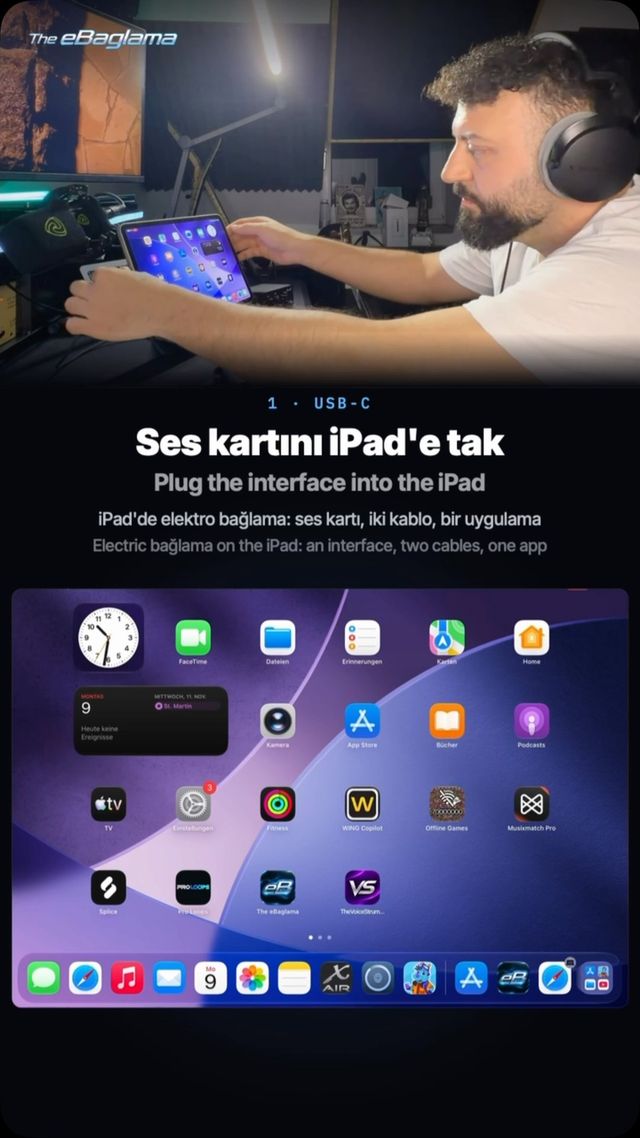
That same day, the developer posted two TikTok explainers. One said: "Downloaded the app but can't hear the effects? Tap '7-day free trial' first, or you only get the dry signal." The next day (11-10) came a four-step tutorial: connect the soundcard to the iPad via USB-C, open the app, plug in the instrument, tune, pick a preset, play. That video reached 2,910 views and 26 shares, the most-shared post on the account. 11-13 Another three-star review followed in the Turkey store on the same theme: "Installing, using it, and which pedals to pair with it, could you cover that too?"
Together these reviews describe the user clearly: working or semi-pro musicians who have a mixer and a soundcard and perform live. They are willing to pay, but between installing the app and getting sound out on stage there is a chain of gear to connect, and someone has to walk them through it step by step.
What it is: a pedalboard tuned to the bağlama
The bağlama is a long-necked plucked instrument from Turkey and Kurdish regions. Fitted with a pickup it becomes the electric saz, common at weddings, bars and türkü (folk song) performances. Players used to either rely on simple onboard effects circuits built into the instrument, or use guitar multi-effects like the Boss GT-10 or Zoom G1 Four and tweak a "bağlama tone" by hand. YouTube is full of tone-tweaking tutorials for exactly that.
The positioning line from The eBaglama's launch video says it all: "Made for the electric bağlama, not borrowed from guitar." Specifically (from the App Store description, website and 1.0.3 release notes):
- Pickup matching: play for 10 seconds and the app learns your pickup's response, then automatically cuts the nasal honk near 2.2 kHz.
- Transposition like a capo: ±12 semitones, placed ahead of all effects. Live mode responds within milliseconds; Precise mode keeps the sympathetic strings in tune. Different singers need different keys, and players use this every day.
- Makam-based harmony: choose a tonic, then a mode from Turkish music such as Uşşak, Hicaz, Kürdi, Rast or Saba. Harmonies added will always fall within the mode. Guitar effects harmonizers only know Western major and minor, so they can't do this.
- Stage features: 230 presets across 16 categories, organized by local styles such as Türkü, Halay, Arabesk and Uzun Hava. Each song has 4 scenes, switchable via MIDI footswitch, with a large-text stage UI. It can route into GarageBand and AUM.
- 1.0.3 (shipped the night of launch): added 74 presets, including 20 electric-saz leslie (rotary speaker) tones and 24 Kurdish wedding dance granî tones. It also supports a dual-input soundcard running bağlama and cura (small saz) at once. Earlier, the title of the desktop version's 11-05 1.0.2 update post was "İstediniz, ekledik!", meaning "You asked, we added it!"
Pricing: free download, 7-day full-feature trial, and without a purchase you're left with dry signal only. One-time purchase. The Mac/Windows plugin is sold separately on the website at a list price of €79 and a promo price of €49, purchased apart from the iOS version.
How much the #40 ranking is worth
Start with the numbers (App Store charts, 11-10 to 11-15):
- Turkey Music Top Paid: 11-10 #111, off the chart for four days in the middle, then #11-15 on 40.
- Turkey Music Top Free: 11-11 peaked at #75 on the day the promo video went out; after that 113, 173 and steadily down.
- Kuwait Music Top Paid: 11-10 #84, then 111, 132, 158, 171, falling a little each day.
- Ratings: Turkey 3 (average 4.33), US 1, Germany 0 (11-14). It shows up daily on category charts in only 1 to 3 countries, and on no overall chart.
#40 sounds decent, but look at the neighbors: the same day #39 was rekordbox (232 ratings) and #41 was an offline music player (45 ratings). The Turkey music grossing bracket has a very low bar: one sale is ₺2.499,99 (about $55), and a few purchases are probably enough to land around #40 (inferred, not verified). Kuwait may need only one sale on some days.
So it proves one thing: some people will pay $45 once for a bağlama-specific tool. But the volume is tiny, likely single-digit purchases a day. The only US review also complains about the price: "$45 isn't crazy, but it's a lot for this product. Maybe $29.99?"
One correction: the website and the iOS app coexist, which makes it look like it was validated on desktop before going mobile. In fact the desktop version is brand new too. The earliest Instagram post is from Oct 20, saying "macOS is out now, Windows coming soon"; the YouTube channel was created Oct 28. The two versions launched just three weeks apart.
Where users came from: the developer's own accounts, plus a push on launch day
Almost nobody outside knows about it. No press coverage turns up in search, nobody mentions it on X, and only one app aggregator picked it up automatically. Users came from three places:
- Own Instagram @theebaglama: 5,427 followers (11-14). Since 10-20 it has posted every two or three days, in Turkish and English, with the profile link pointing to the German App Store. Regular posts get single-digit likes.
- Own TikTok @theebaglama: 299 followers, 34 videos. Most get between 700 and 2,900 views and cover installation, setup and how to buy. The exception is 11-09, "The eBaglama is on the iPad!", with 57,884 views but only 33 likes and 0 shares. Views this high with engagement this low suggests paid promotion (inferred).
- Musician circles: Aydar has played the electric baglama for years and runs his own cover channel. A 11-05 account posted a video of local musician Hamza Sadıklar playing it in a studio, with 1,959 TikTok views. His network in the Turkish-German wedding and live-music scene is real, but how many downloads it actually drove is not visible.
Its strongest acquisition tool is actually credibility: nasal-peak notches, capo transposition, makam, leslie, granî. Insiders recognize these terms immediately as coming from one of their own.
Who's competing: no second app in the space, the real rival is the old workaround
| Competitors | What it is | Compared with The eBaglama |
|---|---|---|
| Boss GT-10, Zoom G1 Four and other guitar multi-effects + hand-tuned tones | Hardware, the mainstream option in the electric saz scene | Hardware is expensive and tones are hand-built. The eBaglama doesn't try to replace it; it can take the GT-10 in as a MIDI footswitch (a GT-10 template is coming in the next version). |
| TonKontrol | Electric saz tones and transposition circuits built into the instrument | Closest in direction, but few effects, no makam harmony and no stage scenes |
| Electric saz with built-in leslie (Sala Muzik and others) | Instruments, from $499 | Effects are locked inside the instrument; The eBaglama works with any instrument |
| BIAS FX 2, AmpliTube, Deplike, NAM Player | General guitar effects apps | Don't understand the bağlama's frequency range; harmony only knows Western scales |
| Volko Baglama and other sampled libraries | Desktop plugins that play saz sounds from a keyboard | For composers, not for playing a real instrument; a different user base |
| Saz Tuner and similar (iOS 12.6k ratings) | Tuners, simulators, lessons | Plenty of volume, but nobody builds an effects product |
Searching "baglama" or "saz" in the App Store returns 35 apps, and Google Play returns 6. They're all tuners, simulators, lessons or name collisions. There is no second effects app. SazAI – Bağlama, launched around the same time, also says "made for the bağlama, not for guitar," but it's a tuner.
If it were you
One-line verdict: There's something to learn here, but following it isn't worth much. This slot for the bağlama is already held by someone who understands DSP and is a player in the scene, and the whole market is small. What's worth learning is the approach, not the lane.
Who it suits: developers who are already electric players of some folk instrument and also write audio DSP. Examples: oud, bouzouki, duduk, electric erhu, pipa, sitar. You have to be able to play it yourself to know where its nasal honk sits in the frequency range, which timbres local players most want on stage, and how to add harmony within its modal system (makam, raga, dastgah, or pentatonic scales).
Not for: anyone hoping to make big money from this. The people who can use it need to play electric instruments, have an audio interface, and perform live, so the global pool might be a few tens of thousands (unverified). The ceiling is "small and premium." It's also not for developers who don't know this instrument: the moat here is knowing the instrument, and outsiders end up with yet another guitar-effects reskin. And building yet another bağlama effects app is a bad bet, since the user pool is too small to fit two players.
How to do it:
- Pick an instrument: look for one that's already electrified, has demand from weddings or bar gigs, and where players are stuck making do with guitar gear. Search YouTube for "[instrument] + Boss/Zoom tones." The more tutorials there are, the more people are making do.
- Build the product: correct for this instrument's acoustic quirks, do harmony and transposition according to its modal system, sort presets by local musical style, and add stage scenes and MIDI footswitching. Let users run their existing hardware as the footswitch to lower the cost of switching over.
- Pricing: a 7-day full-feature trial, after which only the dry signal passes. One-time purchase of $30 to $50. Sell the desktop plugin and the mobile app separately.
- Fill the gap it left: the step from "installed" to "making sound." Reviews on day one are asking for connection tutorials, so build the wiring for common audio interfaces and mixers into the onboarding.
How to get users: the developer appears on camera playing, with bilingual short videos; recruit one or two local players to record demos; spend a little on promoting a main video on launch day; then add presets fast based on comments and post an update each time saying "you asked, we added it." Media and big accounts barely matter here. This community spreads through word of mouth and live gigs.
When to move: no rush. This isn't a platform loophole or a one-off event. Every instrument's slot is there, and whoever arrives first takes it. What you're racing for is your instrument's slot, so don't let another insider build it first.
Signs that would mean you read it wrong:
- By late December, The eBaglama's rating was still in single digits and it had dropped off the Turkish Music Top Grossing chart. That means the $45 one-time purchase only reached the developer's own circle, the model's ceiling is lower than expected, so don't follow it.
- On the flip side, if its ratings climbed into the dozens or hundreds and it stayed in the Turkish and German Music Top Grossing top 50 for a long stretch, that would mean folk-instrument players will pay premium for dedicated tools, and the value of following up with another instrument goes up noticeably.
- If a second bağlama effects app appears and gets traction quickly, that means this slot is bigger than it looks, and insiders are already racing for it.
Ads it's running
Meta has shown us 7 ads; 5 are still running, earliest from Nov 2026 9.
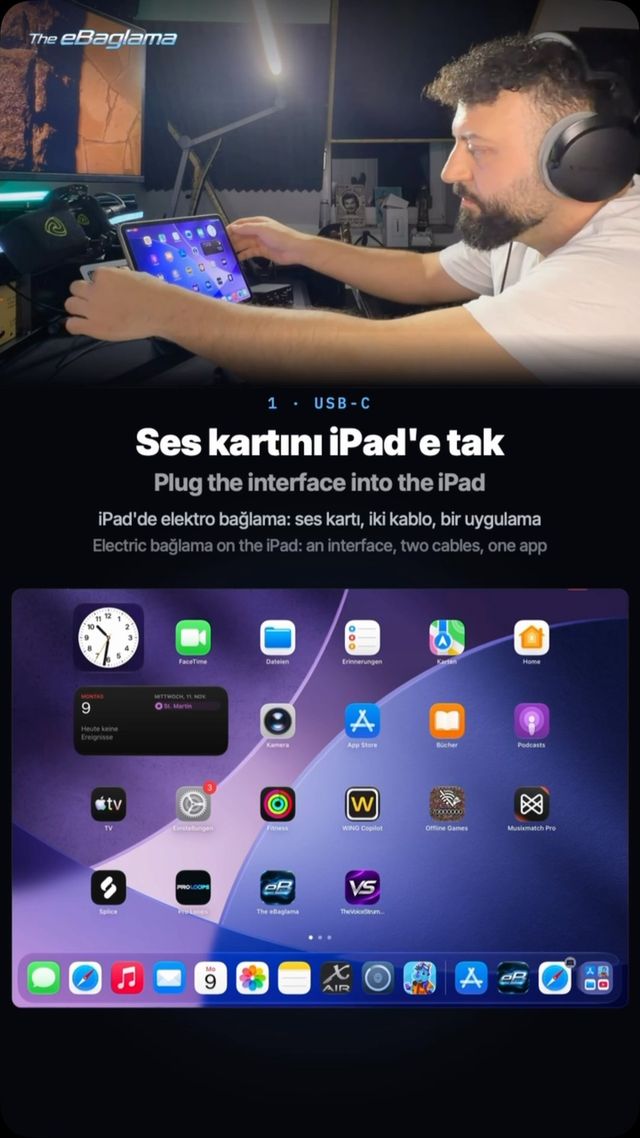
Meta · Video · Running for 9 days · Still running · 2 versions · View original ↗
🎸 Elektro bağlamanı iPad’e bağla ve çal! 1️⃣ Ses kartını USB-C ile iPad’e tak 2️⃣ The eBaglama’yı aç 3️⃣ Bağlamayı ses kartına tak, akort et 4️⃣ Preset seç ve çal – Lesli, oktav, chorus, wah, ambient… Tek dokunuşla transpoze 🔥 Önce “7 gün ücretsiz dene”ye doku…
Meta · Video · Running for 3 days · Still running · 2 versions · View original ↗
🔥 The eBaglama 1.0.4 yayında – iPhone, iPad, Mac ve Windows! 📱 iPhone & iPad: artık süresiz ücretsiz sürüm – 3 preamp, 3 drive pedalı, kompresör, EQ, delay, modülasyon, reverb ve 25 preset hemen çalar. Tam sürümü 3 gün ücretsiz dene. ✅ Şarkı & Kayıt: şarkını y…

These are the longest-running ads in this set. Long runs usually mean the creative is working. Data comes from the official Meta, Google and TikTok ad libraries and updates daily; open the official library to view the original creative.
Research notes: competitor table, acquisition evidence, full research report
- Competitors
Name Where Launched Scale How it differs from this one Boss GT-10/GT-1, Zoom G1 Four and other guitar multi-effects + player-made bağlama tones Other Years ago The mainstream setup in Turkey's electric saz scene. Lots of bağlama tone tutorials on YouTube, and people in Facebook groups recommend the GT10 Hardware is expensive and you have to dial in tones yourself. eBaglama offers ready-made bağlama presets, and you can even use your GT-10 as a MIDI footswitch. TonKontrol electric saz digital tone/effects circuit Other Years ago Niche hardware module Module built into the instrument. Few effects, no makam harmony, MIDI, or stage scenes. Deplike iOS 2017 Turkish iOS app with 9 ratings; Play claims a million users (unverified) Generic guitar effects, not tuned for bağlama, no makam BIAS FX 2(Positive Grid) iOS 2020-05 1,231 iOS ratings in the US For guitar. Harmony only recognizes Western scales. AmpliTube / TONEX(IK Multimedia) iOS 2010 / 2022 Few iOS ratings. Best Turkish AmpliTube Top Paid rank is #86 Generic guitar effects NAM Live / NAM AUv3, ToneStack PRO iOS 2021–2026 US iOS with 16–91 ratings Generic amp modeling / NAM player. eBaglama can also load NAM. Volko Baglama, Soundiron Electric Saz, bujaabeats saz VST Other 2014–2026 Niche desktop sample library Sample instruments that make bağlama sounds from a keyboard, for composers. eBaglama is an effects unit for playing the real instrument. Bağlama tuners / simulators (Saz Tuner, Bağlama Tuner, Baglama Sim, etc.) iOS 2013–2025 Saz Tuner iOS 12.6k ratings; largest on Play with 1.18M installs Tuning, virtual playing, and teaching only. No effects. - Where users come from
- Verified Own Instagram @theebaglama: 5,427 followers; since 10-20 posting a Turkish/English bilingual post every 2–3 days, with the profile link pointing to the German App Store
- Inferred Paid promotion of the launch video: TikTok launch video 11-09 views, 57,884 plays, only 33 likes and 0 shares; the account's other videos got 700–2,900 views
- Verified Own TikTok / YouTube tutorials: TikTok 299 followers, 34 videos; YouTube channel created 10-28, 7 videos with 1,099 total views, covering installation and purchase tutorials
- Verified Local player demo: 11-05 posted a studio performance video with Hamza Sadıklar (135 YouTube views, 1,959 TikTok plays)
- Verified Promo pricing + fast updates on user request: desktop regular price €79, promo price €49; 1.0.3 added the lesli and Kurdish granî presets users asked for, 74 presets in total
- Inferred Media / X / big accounts: Jina and Exa found no press coverage; x-radar has 0 entries
The eBaglama (iOS 6826705085) research report
In one line: The eBaglama is an effects unit for the electric bağlama (electric saz) built by one person, Bünyamin Aydar, a Turkish-born musician and sound designer based in Hamm, Germany. It's a digital pedalboard tuned to the bağlama's range (pickup matching, a transposer that works like a capo, a harmonizer that follows makam, amp/pedal/cab modeling, and MIDI footswitching). In late 2026-10 the desktop plugin came first (€49 for Mac/Windows), followed by iOS in 11-08 (free download, 7-day trial, one-time in-app purchase of $44.99 / €49,99 / ₺2.499,99). It got noticed because on day 7 after launch (11-15) it reached #40 on the Turkish Music Top Grossing chart. The reality: this is a very small, just-emerging signal, not a breakout yet. There are only 3 ratings worldwide. It charted because a high price and a low entry bar on the Turkish Music Top Grossing chart combined. The traffic comes from the developer's own Instagram and TikTok accounts, plus one video pushed on launch day. There's no outside press or big-account coverage.
1. How to read the data (first, some corrections)
- Chart trajectory (appstore library chart_rank / app_day, 2026-11-10 to 11-15):
- Kuwait Music Top Grossing: 11-10 #84 → 11-11 #111 → 11-12 #132 → 11-13 #158 → 11-14 #171, sliding steadily down. Kuwait's chart bar is very low, so a couple of purchases is enough.
- Turkey Music Top Grossing: 11-10 #111,11-11 through 11-14 not charted, 11-15 #40 (the recall was based on this day).
- Turkey Music Top Free: 11-10 #203 → 11-11 #75 (best) → 11-12 #113 → 11-13 #173.
- Germany Music Top Free: 11-11 #206, charted for only one day.
- The number of countries charting each day is 1–3. It doesn't appear on any overall chart.
- Ratings: iTunes lookup (2026-11-14) shows 3 ratings in Turkey averaging 4.33, 1 in the US (5 stars), and 0 in Germany. The daily rating count in the library bounces between 0 and 2 (Turkey's rating_delta on 11-15 was −1). The sample is too small to show a trend.
- What the chart spot is worth: on the same day (11-15), #39 on Turkey's Music Top Grossing was rekordbox (232 ratings), #41 was an offline music player (45 ratings), and #42 was Muud (TTNET, 29k ratings). The bar for this slot is not high. The in-app purchase is ₺2.499,99 (about $55). My guess is that a few purchases would be enough to put it around #40 (inference, unverified). So the "high price, people actually paying" part holds, but the scale is probably single-digit purchases a day.
- Where the recall rationale needs correcting: the recall said it was "validated on desktop before going to iOS." In fact the desktop version was only just out too. The earliest Instagram post is from 10-20 and says "Available now for macOS, Windows coming soon." The YouTube channel was created 10-28. The 10-26 post says "Mac & Windows." 11-05 posted a "tanıtım fırsatı" saying the regular price is €79 and the promo price is now €49. The two versions were only about 3 weeks apart, so there was no real desktop validation first.
2. What the product is
(Sources: App Store description, official site theebaglama.com, 1.0.3 version release notes)
- Pickup matching: play for 10 seconds and the app learns your pickup's character, then automatically tames the nasal peak around 2.2 kHz typical of the bağlama. Works with both single-coil and double-coil pickups.
- Transpose ±12 semitones, placed before all effects. Live mode has a 4–8 ms delay, like a transposer pedal. Precise mode has less than 0.2 cents of error, so drone strings stay in tune when they ring together. This replaces the capo, which matters a lot for the bağlama because different singers need different keys.
- Harmonizer follows makam: pick the karar (tonic), then the makam or ayak (Uşşak, Hüseyni, Hicaz, Kürdi, Karcığar, Rast, Nihavend, Saba, Segah, Hüzzam, Kerem, Garip…), and the harmony notes always fall within that scale. Guitar effects harmonizers only know Western major and minor scales, which guitar apps can't do.
- 22 preamps (6 tuned for the bağlama), 14 single pedals, 11 cabinets. You can load NAM captures and IRs. Also includes compression, EQ, octave, wah, phaser, chorus/flanger, saturation, rotary speaker (Leslie), delay, 14 reverb types, and feedback suppression.
- Designed for the stage: presets sorted into 16 categories with unified loudness; a 40-preset footswitch library with 4 scenes per song that switch seamlessly; a setlist and a large-text STAGE screen; every knob supports MIDI learn. Supports AUv3, so you can run it inside GarageBand, AUM, or Cubasis.
- Presets sorted by local style: Türkü, Halay & Oyun Havası, Arabesk, Uzun Hava. 1.0.3 added 74 more, including 20 LESLİ presets and 24 Kurdish wedding dance GRANÎ presets. The UI is available in 14 languages, including Kurdish, Azerbaijani, Arabic, Persian, and Greek.
- Pricing: free download, a 7-day full-feature trial, then a one-time purchase, no subscription. Without a purchase, only the dry signal passes. The desktop version is sold via Lemon Squeezy at €49, separate from the iOS version.
3. Competitors
| Competitors | Platform | Launched | Scale | How it differs from The eBaglama |
|---|---|---|---|---|
| Boss GT-10 / GT-1, Zoom G1 Four and other guitar multi-effects + player-made "bağlama tones" | Hardware | Years ago | The mainstream setup in Turkey's electric saz scene. People in Facebook groups say "the GT10 is the best on stage"; YouTube has lots of "Boss GT 10 Bağlama Sesleri" and "Zoom G1 Four Bağlama" tone tutorials | Hardware is expensive, and you still have to dial in tones yourself. eBaglama packages bağlama tones as ready-made presets, and you can use your GT-10 directly as a MIDI footswitch (11-13 posted that a GT-10 template is coming in the next version). It plugs into hardware existing users already have, rather than replacing it. |
| TonKontrol(tonkontrol.com) | Hardware (circuit built into the instrument) | Years ago | Niche: a circuit board that sells for the electric saz to add effects, digital tone control and pitch shifting, aimed at the "16" electric baglama. | Closest opportunity match (pitch shift + effects, built specifically for the baglama), but it's a module you install inside the instrument, with few effects and no makam harmony or MIDI stage control |
| Electric sazes with built-in lesli / rhythm presets (Sala Muzik, Sultan Instrument, etc.) | Hardware (instrument) | Years ago | Sold from $499 | The effects are hard-wired into the instrument; eBaglama is software, so any baglama can use it |
| Deplike (Turkish company) | iOS / Android / desktop | 2017 | Only 9 ratings on the Turkish iOS store; the Play page claims a million users (unverified) | Generic guitar amp and effect modeling, with no baglama-specific tone design and no makam support |
| BIAS FX 2(Positive Grid) | iOS / desktop | 2020 | 1,231 iOS ratings in the US | Built for guitar, its harmonizer only understands Western scales |
| AmpliTube / TONEX(IK Multimedia) | iOS / desktop | 2010 / 2022 | Very few ratings on the US iOS store; in Turkey, AmpliTube's best Top Paid ranking was #86 | Same as above |
| ToneStack PRO, NAM Live / NAM AUv3, etc. | iOS | 2021 / 2026 | US iOS with 16–91 ratings | Generic amp modeling and an NAM player; eBaglama can also load NAM, so it bundles these in |
| Volko Baglama, Soundiron Electric Saz, bujaabeats saz/baglama VSTs | Desktop VSTi | 2014–2026 | Volko released v2 in 2015; bujaabeats published a saz VST guide in 10-27 | These are sample libraries (playing baglama sounds from a keyboard) aimed at composers; eBaglama is an effects processor for real instruments. The users aren't the same people. |
| Baglama tuners / simulators / learning apps (Saz Tuner 12.6k ratings, Bağlama Tuner 1,444 ratings, Baglama Sim, Bağlama Saz Çal) | iOS / Android | 2013–2025 | The biggest tuner on Play has 1.18M installs (googleplay library) | They do tuning, virtual playing and teaching; none make effects processors |
Conclusion: no second "electric baglama effects" app exists on iOS or Android. Searching the appstore library for baglama / bağlama / saz returns 35 apps, and the googleplay library 6; all are tuners, simulators, teaching tools, or name collisions. Its real competition is the old approach: a general guitar multi-effects unit and tweaking the tone yourself.
4. Growth tactics (where users come from)
| Channel | Evidence | Confirmed |
|---|---|---|
| Own Instagram @theebaglama | 5,427 followers (2026-11-14). Posts started on 10-20, roughly every 2–3 days, in Turkish and English; the profile link points to the German App Store. Regular posts get single-digit likes (the 10-26 post got 2 likes). | Yes |
| Probably paid promotion of the release video (inferred) | TikTok @theebaglama: the video "The eBaglama artık iPad'de!" from 11-09 has 57,884 plays but only 33 likes and 0 shares; the account's other videos sit at 700–2,900 plays. High views with low engagement looks like money spent on a boost (TikHub, 2026-11-14) | No (inference) |
| Own TikTok / YouTube | TikTok: 299 followers, 34 videos, 1,406 likes. YouTube channel created 10-28: 20 subscribers, 7 videos, 1,099 total views. The content is all install tutorials, setup, and how to buy. | Yes |
| Local musician demos | 11-05 posted a video of musician Hamza Sadıklar (448 YouTube subscribers) playing it in a studio (135 YouTube views, 1,959 TikTok plays) | Yes (very small scale) |
| The developer's own musician network | Aydar is an electric baglama player himself, with a YouTube channel (E-bağlama covers), Spotify singles (72 monthly listeners), and Instagram @bunyaminaydar. The Turkish wedding and gig scene in Germany is his personal network. | Partly (no evidence of how network turned into downloads) |
| Promo pricing, fast version updates | Desktop version "€79 → promo price €49". Within 5 days it went from version 1.0.2 to 1.0.3, adding the lesli and granî presets users had asked for ("İstediniz, ekledik!" = you asked, we added it!) | Yes |
| Store search | Posts tell users to search "The eBaglama" on the App Store; the keyword "bağlama" has almost no effects-app competition on the App Store | Partial |
| Media / X / big accounts | Jina and Exa find no media coverage; x-radar shows "ebaglama" appearing 60 times in the last 0 days; only one unclaimed listing auto-indexed by the app discovery site debuts.app | Confirmed none |
| Meta Ad Library | The metaads library shows nothing by page name, domain, or App id (this library only tracks advertisers found through keyword discovery, so a miss doesn't mean they didn't advertise) | No |
5. Why it charted (and why it still isn't "breaking out")
- Price × barrier to entry: one-time purchase at ₺2.499,99 / $44.99. The barrier near #40 on Turkey's Music Top Grossing chart is low; the neighbors are apps like rekordbox and Muud with only a few hundred ratings. A few purchases can be enough to chart, and on the Kuwait day a single purchase may have done it (inferred).
- A vacuum in a niche need: among Turks, Turkish diaspora in Europe, and Kurds, many musicians play electric saz at weddings, bars, and türkü gigs. Until now they had to dial in tones on guitar effects like the Boss GT-10, and asked each other in Facebook groups "what effects for electric saz?" The App Store had no effects app built for the baglama.
- The developer is the user: Aydar plays electric baglama himself and has years of E-bağlama covers. He knows the 2.2 kHz nasal peak, why pitch shifting should replace a capo, why harmony has to stay within makam, and why weddings need lesli and granî. Those details make insiders think "this was made by someone who knows the instrument."
- Own content plus a launch-day push: Instagram built hype for 3 weeks (from 10-20), a post on 11-07 announced "on the App Store Monday," and the launch video on 11-09 was boosted to 58k plays. The iOS version hit #75 on Turkey's Music Free chart around 11-11, matching the timing of that video.
- Not "breaking out" yet: 3 ratings worldwide, charted in 1–3 countries, and the Kuwait ranking slid steadily. Some people pay, but volume is small.
6. Differentiation
- What's different: it isn't a guitar effect with a new skin. It's rebuilt for the baglama at two levels, DSP and music theory: pickup / nasal-peak correction, pitch shift instead of a capo, makam harmony, and local tones like lesli and granî. It also connects common hardware (the GT-10) as a foot controller. Guitar apps don't understand makam, and baglama apps only tune and offer virtual playing, so it sits in the gap between them.
- Is this why it charted? Yes. Because the niche is so narrow that no competitors exist, it could charge $44.99 one-time and people were willing to pay. The same narrowness sets the ceiling: users need an electric saz, an audio interface, and a stage. Global volume may be only tens of thousands of people (unverified). So it looks more like a "small but premium" business than a hit.
7. What's worth borrowing
- Template: find an acoustic folk instrument that is already electrified and performed live, but where players make do with guitar gear. Examples: oud, cümbüş, bouzouki, duduk, electric erhu / pipa, sitar. Build a dedicated effects processor: tune the tone to that instrument's acoustics, build harmony and transposition around its scale system (makam, raga, dastgah), and organize presets by regional style. A one-time price of $40–50 fits.
- Distribution: the developer is a player who posts bilingual short videos from his own account; spend a little on boosting the main video on launch day; then get one or two local musicians to record demos. Using existing hardware as the foot controller (the GT-10 template) lowers the switching cost for existing users.
- Pricing: a 7-day full-feature trial, after which only dry sound remains, with a one-time purchase. Desktop and mobile are sold separately.
8. Copycats
Nothing like it yet. The closest in timing are SazAI – Bağlama (listed 11-09, a tuner whose copy says "built for the bağlama – not for the guitar", similar wording but different function), Tını: Bağlama & Saz (11-04, virtual playing), and BağlamaApp (10-28, a tuning calculator). None are effects processors.
9. Still unclear
- Did it chart from real purchases, or from the developer and friends buying it? Downloads and revenue aren't visible, and how many purchases the #40 spot represents is inferred.
- Was the 11-09 TikTok with 58k plays paid for? Were the Instagram's 5,427 followers bought through follower ads? Neither is confirmed.
- The split of users across Turkey, Germany, and Kuwait.
- Whether Apple editors featured it (not found).
- How many desktop copies sold (Lemon Squeezy doesn't publish this).
- The total number of electric baglama players, which sets the ceiling.
Sources
- App Store: apps.apple.com/tr/app/the-ebaglama/id6826705085 (in-app purchase ₺2.499,99,3, ratings and reviews), us page (in-app purchase $44.99, users say it's too expensive and suggest $29.99), de page (49,99€); iTunes lookup / review RSS (2026-11-14)
- Website: theebaglama.com/ (desktop €49, original price €79, Lemon Squeezy, 14 languages)
- Instagram: www.instagram.com/theebaglama/ (5,427 followers; posts 10-20, 10-26, 11-08, 11-09, 11-12)
- TikTok (TikHub): @theebaglama, 299 followers, video play data (2026-11-14)
- YouTube Data API: channel @theebaglama (created 10-28, 1,099 views); Hamza Sadıklar demo video g2KxqOgQkpY
- appstore library: chart_rank / app_day / app_profile (2026-11-10 to 11-15); googleplay library (Baglama-type app installs)
- metaads library (no results); x-radar (0 posts)
- Competitors: tonkontrol.com; Facebook group "Elektro saz için hangi efekt pedalı önerilir?"; YouTube baglama tone videos on Boss GT-10 / Zoom G1 Four; volkoaudio.com; bujaabeats.com/guides/saz-baglama-vst; debuts.app/apps/the-ebaglama