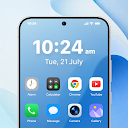
A desktop that answers your calls for you: an Indian indie dev's launcher, 3 months, 260k installs
What it is An Android home-screen app that also works as your dialer and SMS app. You set it as default home, default phone and default messaging app, and it makes money from ads.
Why it took off By holding three system entry points (after a call ends, when apps are installed or removed, when the charger is plugged or unplugged) it can show ad screens, so each user is worth more. Then it bought traffic on a daily on/off schedule, rotated names through updates, and spread into personalized category charts across more than a hundred countries where the bar is low.
CHow you could follow Don't copy the home screen + phone + SMS combo, which is already crowded. A team with experience in utility and ad-driven apps could change the entry point or the audience (for example, a large-text home screen with a dialer for older users, or localization for a specific language or device type), make the after-call screen genuinely useful, and fill in permissions and data-safety declarations honestly.
- Data (updated daily) · first launch 2026-09-11 · 11-07 installs 258,849
Android · Total installs worldwide Data 2026-10-29 → 2026-11-07 (10 days, 10 observations). Google's detail page only refreshes install counts every other day, so a flat day doesn't mean nobody installed.Android · Ratings count (cumulative) Data 2026-10-29 → 2026-11-07 (10 days, 10 observations)
An Indian indie dev's Android home screen that also asks you to set it as your default phone and default SMS app. The product has nothing new: it launched in August and reached 259k installs by 11-06. It works by holding three system entry points and running an on/off ad-buying schedule. The playbook is worth studying, but it's too late to join the crowd.
A review from October 27
On Oct 21, "Launcher: Phone & Messages" shipped v1.9 on Google Play. According to AppstoreSpy estimates, it added about 23.5k installs that day, its biggest day since launch.
Six days later, a user named Josephine Kerubo left a review on the store page: "when i tap it doesn't work out" (tapping it does nothing). By 11-06, 26 people had marked it helpful, the most-liked review in the store page's list. The second was "That was good 👍", with 20 helpful votes.
These two reviews pretty much sum up the app: user numbers grew fast, but many users can't say what they installed or why it's good. Its 4.5 rating from 709 reviews (Play store page, 11-06) against 259k installs means the review rate is under 0.3%.
What it actually is
The store page title reads "Launcher: Phone & Messages", but the first line of the description still uses the old name "Your Smart Home for Calls & Messages". The features fall into three areas:
- Home screen: replaces the phone's built-in home screen, with an app drawer, search, wallpapers and widgets.
- Dialer: keypad, call log, contacts. The description states that "some phone features require setting Smart Home as your default phone app".
- Messages: send and receive SMS, which likewise requires setting it as the default messaging app.
The last three items on the feature list are the most telling: "after-call screen", "view the install and uninstall history of apps on the device", and "instant alerts when a charger is plugged in or unplugged". The store page is labeled "Contains ads" and has no in-app purchases.
The developer is Beyond App Solutions. The "About the developer" section lists a personal name in India, and the contact email is Gmail. The website is an empty Blogspot, and the privacy policy is a Google Sites template. The data safety section says "no data collected," but a default SMS app has to read SMS and call logs.
How it grew
| Timeline | Total installs | What happened |
|---|---|---|
| 08-07 | 0 | Listed as "Launcher: Home Screen – Fast & Customizable," just a home screen (APKPure version history) |
| 09-09 | About 29k | A thousand or two a day, growing slowly |
| 09-10 | About 43k | Renamed "Smart Home: Phone & Messages" and added dialer and SMS, +14k a day. The store listing date was reset to 09-11. |
| 09-24 | About 86k | Scaled up steadily |
| 09-25 → 10-07 | 87k → 97k | Nearly flat, most days only a few dozen to a few hundred |
| 10-08 → 10-27 | 104k → 209k | Scaled up again. On the day 10-21 shipped v1.9, +23.5k |
| 10-29 → 11-06 | 209k → 259k | +49k over 7 days, about 6 thousand a day (Google Play installs) |
The single-day numbers before 11-06 are AppstoreSpy estimates. Use them for shape only, not as exact figures.
The shape makes the point. Organic growth doesn't go from tens of thousands in one day to a dozen days of only dozens. This looks more like paid acquisition being switched on and off, and each re-scale lines up with a rename or release. (Inference: no ads from this app showed up in Google's or Meta's public ad libraries, but that doesn't mean none ran.)
In 3 months it has had 3 names: first "Home Screen," then "Smart Home: Phone & Messages," now "Launcher: Phone & Messages." Each rename swaps the keywords. The September rename also reset the listing date, which probably brought another round of new-app traffic (inference).
Where users come from
This is not word of mouth. In the last 90 days, searches on X for the package name and product name each returned 0 posts. On TikTok, the results were all other launchers. There are no reviews anywhere online, only auto-aggregator sites like APKPure and AppBrain.
It's paid acquisition plus small-country category charts. 11-06 It has charted in only one category: the free "Personalization" chart, across 20 countries and regions. Its best rank is #30 in South Korea, followed by Nigeria at #44, Thailand #55, Japan #74, and Germany #88. The US ranks #136 (Google Play charts, 11-06). AppBrain data shows it charting in 112 countries, with Brazil around 8.3% of installs and the US 6.6%. It ranks high on trending charts in small markets like Guinea-Bissau, Myanmar, Qatar, and Burkina Faso.
The Personalization category has a low bar in many countries. About 5–6 thousand installs a day worldwide, spread across more than a hundred countries, is enough to chart in a whole list of countries at once. Charting also picks up a bit more browse traffic.
The name looks like a system app. Names like "Phone & Messages" and "Smart Home," paired with a generic icon, convert well with people who can't tell system apps from third-party ones. That mostly means users in emerging markets and older users. The review that complained it did nothing is one of these users.
Where the money comes from
It's ads only. The app doesn't state where the money comes from, but its feature list makes clear where the ads go (inference, not verified by installing the package):
- Default home screen: every phone unlock passes through it.
- Default phone app: after every call, a "call ended" screen pops up. This is the most common placement for utility ad apps.
- App install/uninstall, plugging in the charger: each one shows a reminder screen, another ad impression.
Most similar apps take just two entry points (home screen plus SMS, or home screen plus dialer). This one takes three, so a user sees far more ads per day than from a typical utility. That's why it can afford paid acquisition: each user is worth enough that it can buy daily and stop when the numbers don't add up.
Who it's competing with
By 2026, this category on Google Play was crowded. More than twenty apps have launcher plus phone, SMS, call, or contact in the name, and several are growing faster than this one each week:
| Product | Launched | Scale (Google Play installs, around 11-06) | Compared with alternatives |
|---|---|---|---|
| Messenger: SMS Home Launcher(Telloa Tools App) | Package is from 2018, repurposed | 3.3M, 7 days +147k | Repurposes an old package, skipping new-account cold start |
| Messenger: SMS Home Launcher(JB DEVELOPER APP) | 2025-11 | 3.04M, 7 days +77k | SMS + home screen, a year earlier, ten times bigger |
| Phone Call: Messaging Launcher(Safe & Secure Proxy Tools) | 2026-02 | 906k, no longer charting | Same combo as this one, 7 months earlier, scale-up already over |
| Contacts - Phone Call Launcher(EverCoreTech) | 2026-07 | 510k, +46k in 7 days | Targets the Europe/US "Communication" category chart, #17 in Sweden |
| Messages: SMS & Call Launcher(Operonix Apps) | 2026-09-30 | 71k, +22k in 7 days | Nearly identical combo, launched later |
| OS Launcher(NTStudio) | 2024-11 | 6.6M | Sells an "Android as iPhone" look |
Add the built-in system launcher, Google Phone, and Google Messages: same functions, no ads, preinstalled on every phone. The developer is also running sock puppets. Under the same account is "Home Launcher," with 10k+ installs and 10-30 just updated.
It didn't move first and has no unique feature. It worked because the template was solid and the paid acquisition was executed well.
Pitfalls on this path
Google Play polices SMS and call-log permissions tightly. Only apps that really become the default SMS or phone app can request them, and you have to fill out a permissions declaration form. There are also specific policies on interruptive ads and on honest data safety disclosures. This app's data safety section says "no data collected," which doesn't match what it actually reads. Apps like this get delisted or accounts banned all the time, which is why people in this space keep shipping new packages, new accounts, and renaming old packages. That shows it makes money, and also that it won't last long.
If it were you
C: Worth learning the playbook, not worth copying. This is an ad-arbitrage business, not a product business. The category is saturated: the leaders are veterans with millions of installs, repurposed old packages, and rotating multiple packages. If you build an identical one, you compete on paid-acquisition budget, review experience, and how fast you can switch packages after a ban. Indie developers don't have an edge on any of those.
Who it suits: small teams that have already shipped utility ad apps on Google Play (cleaners, wallpapers, flashlights), have an AdMob or mediation account, can run Google App Campaigns, and can work out payback day by day. For you, this is a new package type: take one more default entry point and you get one more ad placement.
Who it doesn't suit: anyone who wants to build a product users recommend on their own; anyone who hasn't run paid acquisition and is counting on organic traffic; anyone with a single developer account who can't afford a ban.
How to approach it: don't copy "home screen + phone + SMS" as is. Someone was already doing this in February, and another company launched in late September. What might work is changing the entry point or the audience: for example, a large-text home screen with dialer for older users, or localizing for one language or one phone brand. Make the call-ended screen actually useful (caller ID, call notes), not just an ad slot. Fill out the permissions declaration and data safety section honestly.
How to acquire users: paid acquisition, mainly Google App Campaigns. Buy the low-barrier categories, "Personalization" or "Communication," and chart in dozens of countries at once. Pair each rename or release with a wave of spend. Prove per-user value in emerging markets on a small budget first, then decide whether to spend more.
How early you need to be: there's no clear window. This category has been growing from 2025 to now. But every month new followers with the same combo ship, and the later you come in, the more expensive it gets.
Signs you've misread it: ① Operonix and another app of this type were delisted or stopped updating before January 2027, which suggests Google is tightening up and this package type is on its way out. ② Conversely, if in three to five months it is still gaining thousands a day and starts showing paid ad-removal or subscriptions, users are really staying. At that point it's more than arbitrage and worth a serious look.
Research notes: competitor table, acquisition evidence, full research report
- Competitors
Name Where Launched Scale How it differs from this one System home screen + Google Phone / Google Messages Big-company features Preinstalled All Android phones Identical functions, no ads. It just combines three things into one app and adds ad slots. Messenger: SMS Home Launcher(JB DEVELOPER APP) Android 2025-11-17 3.04M installs, +77k in 7 days Same template (SMS + home screen), started earlier, more than 10× the scale, no dialer Messenger: SMS Home Launcher(Telloa Tools App) Android Package is from 2018, repurposed 3.3M installs, +147k in 7 days Repurposed an old package to skip cold start; only SMS plus home screen Contacts - Phone Call Launcher(EverCoreTech) Android 2026-07-17 510k installs, 7 days +46k Dialer + contacts + home screen, targeting the Communication chart in high-value Europe/US markets. This app targets the Personalization chart, which is spread more thinly. Phone Call: Messaging Launcher(Safe & Secure Proxy Tools) Android 2026-02-11 906k installs, no longer charting Same phone + SMS + home screen combo, 7 months earlier, scale-up already over Messages: SMS & Call Launcher(Operonix Apps) Android 2026-09-30 71k installs, 7 days +22k Nearly identical combo, launched later, targeting the Communication chart OS Launcher series (NTStudio / Vector Applications) Android 2024-11 / 2026-06 6.6M / 530k installs Sells an iOS-style look, also targets the Personalization chart, doesn't take over calls or SMS Nova / Microsoft Launcher / Smart Launcher Android Years ago Tens of millions or more (unverified) A proper home-screen product with reviews or subscriptions. Doesn't take over calls or SMS, doesn't show ads on system events. - Where users come from
- Inference Paid acquisition (likely automated buying such as Google App Campaigns): AppstoreSpy's curve switches on and off. 09-10 added +14k in one day, 09-25 to 10-07 most days had only dozens, and 10-21 added +23.5k in one day. Charting is spread across 20 storefronts, including South Korea, Japan, Germany, Nigeria, Thailand, Vietnam, and UAE (during the recall phase AppBrain showed 112 countries). Rating rate is only 0.27%. It doesn't appear in the googleads or metaads libraries, so it isn't on the tracking list.
- Verified Renaming and shipping new versions to chase keywords (ASO): 3 months, 3 names: Launcher: Home Screen – Fast & Customizable → Smart Home: Phone & Messages → Launcher: Phone & Messages; 09-11 that rename reset the store launch date; every traffic spike lined up with a rename or release (APKPure version history, googleplay library)
- Confirmed Small-country Personalization chart: 11-06 on the free Personalization chart in 20 storefronts: #30 South Korea, #44 Nigeria, #55 Thailand, #74 Japan, #136 US (chart_rank).
- Confirmed Default home screen, phone, and SMS, plus system-event pop-ups (retention and monetization): the store description asks users to set it as default home screen, phone, and SMS. It has a call-ended screen, app install/uninstall logs, and charging reminders. Listed as containing ads.
- Inference Content, creators, media: x-radar shows 90 posts in the last 0 days. TikTok search returns no related videos. Only data aggregator sites index it on the web.
Why Launcher: Phone & Messages (com.simple.launcher.homescreen) could break through
Channel: Google Play · Developer: Beyond App Solutions (the store's About section lists an individual in India, GAMIT HINA GAMANBHAI, email [email protected]) · Category: Personalization · Contains ads, no in-app purchases · Research date 2026-11-06
Bottom line
An Indian solo developer's three-in-one "Launcher" reskin: home screen + dialer + SMS. The product itself has nothing new. The play is: take over the three default system slots (home screen, phone, SMS), then use system events like the post-call screen, install/uninstall alerts, and charging reminders to trigger ads. Paid acquisition runs in on-off bursts (installs go from over 10K a day to a few dozen), spread across 100 low-barrier personalization category charts in many countries. It reached 259k installs in 56 days by store date (about 3 months counting from early August). It's a template many people have already proven out. Nothing new here.
1. The data: how it grew
Install curve (googleplay library, app_day and app_day_ext; app_day_ext is AppstoreSpy's estimated history since launch, so don't trust single-day numbers):
| Period | Total installs | Average daily new installs | What happened |
|---|---|---|---|
| 2026-08-07 | 0 | – | v1.0 launched as "Launcher: Home Screen – Fast & Customizable" (APKPure version page) |
| 08-13 → 09-09 | 86 → 29k | about 1–2K | Pure home screen version, slow to grow |
| 09-10 | 43k | +14k in one day | Renamed to "Smart Home: Phone & Messages", added dialer and SMS; store launch date was reset to 09-11; APKPure logs v1.1 on 09-15 and v1.3 on 09-16 |
| 09-12 → 09-24 | 47k → 86k | about 1.3–6.7K | Volume ramps up |
| 09-25 → 10-07 | 87k → 97k | Most days only single digits to a few hundred | Nearly stalled, with one day at 10-04 hitting 4.3K |
| 10-08 → 10-27 | 104k → 209k | About 2–8K, 10-21 +23.5k in one day | Volume ramps up again; v1.9 updated on 10-21 (store updated_at) |
| 10-29 → 11-06 | 209k → 259k | About 6.2K | Our own collected data, +49.4k over 7 days |
- Ratings: 10-29 has 464, 11-06 has 692; adds 20 to 38 a day. 4.5 average, 5-star share is 77% (app_snap.histogram [26,26,39,65,535]). Ratings divided by installs is about 0.27%.
- Charts (chart_rank, 11-06): only charted in the Personalization free category chart, across 20 stores: #30 in South Korea, 44 in Nigeria, 55 in Thailand, 74 in Japan, 88 in Germany, 92 in Spain, 98 in France, Italy and UAE, 118 in Poland, 123 in Canada, 124 in Taiwan, 127 in Saudi Arabia, 133 in Vietnam, 136 in the US. Its best since 10-29 was #30 in South Korea on 10-30. In the recall stage, AppBrain data showed it charting in 112 countries, with Brazil at about 8.3% of installs and the US at 6.6%, and ranking high on trending charts in small markets like GW, MM, QA and BF.
- The same developer account has another app, "Home Launcher" (com.smart.homescreen.launcher): pure home screen, over 10k installs, 105 reviews, 10-30 updates (Play page). Not in our library.
How to read it: Organic growth doesn't switch on and off like this. A day with 10K+ followed by several days of single digits looks more like paid acquisition budgets being turned on and off, with each restart landing right on a rename or release (09-10 renamed, 10-08 and 10-21 released). This is speculation; we found nothing in the ad libraries.
2. Competitors: who else does the same thing
| Competitors | Where | When to get in | Scale | How it differs |
|---|---|---|---|---|
| System home screen + Google Phone / Google Messages / Samsung built-ins | Big-company features | Preinstalled | All Android phones | Full feature overlap, and no ads. It just bundles three things into one app and adds ad slots. |
| Messenger: SMS Home Launcher(JB DEVELOPER APP) | Android | 2025-11-17 | 3.04M installs, 7 days +77k (googleplay library) | Same template, SMS plus home screen. Started much earlier and is more than 10 times bigger. |
| Messenger: SMS Home Launcher (Telloa Tools App; package name is an old 2018 package, com.EducationalGame.MazeForKids) | Android | Package is from 2018, repurposed | 3.3M installs, +147k in 7 days | Same template. Reusing an old package skips the cold start of a new account. |
| Contacts - Phone Call Launcher(EverCoreTech) | Android | 2026-07-17 | 510k installs, +46k in 7 days; #17 in Sweden's Communication chart | Dialer + contacts + home screen. Targets high-value European and US communication category charts; this app targets personalization categories, which spread wider |
| Messages - SMS, Text, Launcher(Decent Story Apps / The Lucky App) | Android | 2026-02 / 2026-04 | 410k / 220k installs | Only SMS plus home screen, no dialer |
| Messages: SMS & Call Launcher(Operonix Apps) | Android | 2026-09-30 | 71k installs, +22k in 7 days; #43 in Taiwan's Communication chart | Almost the same combination (SMS + phone + home screen), launched later |
| Phone Call: Messaging Launcher(Safe & Secure Proxy Tools) | Android | 2026-02-11 | 906k installs, no longer charting | Same combination, already past its ramp-up phase |
| OS Launcher series (NTStudio 6.6M, Vector Applications 530k) | Android | 2024-11 / 2026-06 | See left | Sells an iOS-style look that "turns Android into an iPhone", also targeting personalization category charts |
| Nova / Microsoft Launcher / Smart Launcher | Android | Years ago | Tens of millions to hundreds of millions (unverified) | A legitimate home screen product that doesn't take over phone and SMS |
Bottom line: "Tool + default home screen" Launcher shells already fill a big chunk of the Play store in 2026 (20+ in our library have launcher in the name plus phone/sms/call/contact, and several grew faster than this app over 7 days). It has no first-mover advantage. The same combination, Phone Call: Messaging Launcher, was already out in February, and followers like Operonix showed up by late September.
3. Growth levers: where users come from
- Paid acquisition (presumably automated campaigns like Google App Campaigns, unverified): the install curve switches on and off (see above). Charting countries run from South Korea, Japan and Germany to Nigeria, Thailand, Vietnam and UAE, a spread that doesn't look like it spread through a single community or language. The rating rate is only 0.27%, with 5-star at 77%. Our Google ad library (googleads.adv_app / creative) and Meta ad library (metaads.app_link) both lack this package, but it isn't on our tracking list, so not finding it doesn't mean it isn't advertised.
- Renames and keyword updates (ASO): In 3 months it changed names 3 times: "Launcher: Home Screen – Fast & Customizable" → "Smart Home: Phone & Messages" → "Launcher: Phone & Messages". The store description still says "Smart Home," so only the title changed. Each rename coincided with a ramp-up. The 09-11 rename also reset the store launch date, which may have given it a fresh "new app" traffic boost (speculation).
- Small-country category charts: The Personalization free category chart has a very low bar in many countries. Its 6K daily global installs are spread across 100+ countries, which also puts it in the top 60 in South Korea, Nigeria and Thailand, and high on trending charts in small markets like GW, MM, QA and BF (AppBrain, recall stage). Once charted, it picks up a bit of browse traffic.
- No content, creators or press. x-radar returned 90 results for both the package name and the product name over the past 0 days. TikTok search results show other Launchers. The web has only auto-indexing sites like APKPure, AppBrain, Apptopia and chrome-stats, and no articles or reviews.
- Retention and monetization design (from the store description, confirmed): It asks users to set it as the default home screen, default phone app, and default SMS app. Features include an after-call screen, a view of app install and uninstall history, and charging plug/unplug alerts. These are all triggers that show UI on system events, a display slot that ad-supported utility apps commonly use. The store lists it as containing ads, with no in-app purchases.
IV. Why it made it onto the charts
- Strong placement: The default home screen is exposed on every unlock. Once it takes over calls, every call ends on a post-call screen. Add app install/uninstall and charging events, and a user sees far more ad impressions per day than a typical utility app (from the store's feature list).
- Looks like a system app: Names and icons like "Launcher: Phone & Messages" and "Smart Home" convert well with users who can't tell system apps from third-party ones. That audience is mostly in emerging markets, and includes older users. One review says "when i tap it doesn't work out" (26 people found it helpful), suggesting some users don't really know what they installed (Play page reviews).
- Paid acquisition plus category charts: 5–7K installs a day is enough to hold a spot on personalization category charts in 20 stores (googleplay library). The spend is small and can be paused at any time.
- Very low cost: An Indian solo developer account. The website is an empty Blogspot page and the privacy policy is a Google Sites template. The data safety section says "no data collected," yet the app reads SMS and call logs and shows ads. The cost of building this is essentially one template plus an ad budget.
5. Differentiation
Little differentiation for users. Compared with dozens of similar apps, its only addition is putting three default slots (home screen, phone, SMS) in one app, where most peers take two. That adds ad trigger points, which may be why its per-user value (ARPU) could be higher. But Phone Call: Messaging Launcher (2026-02) came earlier with the same combination, and Operonix's Messages: SMS & Call Launcher (2026-09-30) came later, and both are already competing. So it got traction through template plus paid acquisition execution, not differentiation.
6. Visibility and copycats
- Visibility: Few people know about it yet. Revenue isn't public, there's no press coverage, and it has 0 discussions on X and TikTok, with only data sites auto-indexing it.
- Copycats: The same developer made a sister app, "Home Launcher" (com.smart.homescreen.launcher, over 10k installs). Followers with the same combination include Operonix Apps' "Messages: SMS & Call Launcher" (09-30 listed, 71k installs) and Luka Renatas' "Messages: SMS Text & Home App" (09-219k). The category is already crowded.
7. What's worth borrowing
- Turn high-frequency system-level functions (dialer, SMS, settings, flashlight, cleaner) into a Launcher. One app requests several default roles at once, and system events (call ending, installing/uninstalling apps, charging) become display slots.
- Ramp volume in waves, pairing paid acquisition with renames and releases. Target low-barrier personalization category charts so it charts in many countries at once.
- Risks: Play is strict about SMS and call log permissions, disruptive ads, and accurate data safety declarations. Its data safety section says "no data collected," which doesn't match what the app does, so it could be pulled at any time. This model has a short lifespan and depends on constantly shipping new packages and new accounts.
8. What's still uncertain
- We couldn't find which ad platforms it spends on, how much, or the payback period. None of the three ad libraries lists it. AppBrain and chrome-stats are blocked by Cloudflare, and we didn't get the SDK list.
- We haven't verified whether the post-call screen shows ads or whether it uses AdMob or an aggregation SDK. We haven't installed the package to check.
- Unclear whether the developer runs the paid acquisition or whether a publisher or agency is behind it.
- Unclear whether the stall from late September to early October was a budget pause or Google throttling.
Sources
- googleplay library (agent-im, DuckDB): app, app_snap, app_day_ext (AppstoreSpy estimates), chart_rank, app_profile, developer; 2026-10-29 to 11-06
- Google Play store pages: play.google.com/store/apps/details?id=com.simple.launcher.ho… ; sister app play.google.com/store/apps/details?id=com.smart.homescreen.l… ; developer page play.google.com/store/apps/developer?id=Beyond+App+Solutions
- APKPure version history: apkpure.com/launcher-phone-messages/com.simple.launcher.home… (v1.0 2026-08-07, v1.1 09-15, v1.3 09-16, v1.7 10-01, v1.9 10-23)
- Former names: chrome-stats, AppBrain and APKPure summaries from Jina search results ("Launcher: Home Screen – Fast & Customizable", "Smart Home: Phone & Messages")
- Official site bas-launcher-home.blogspot.com/ (empty blog); privacy policy sites.google.com/view/bas-launcher-privacy/home
- googleads / metaads library: no ads found for this package name; x-radar, last 90 days: 0 posts; TikHub TikTok search: no relevant videos
- Reach data card (AppBrain: 112 countries, Brazil 8.3%, US 6.6%, with ads)